
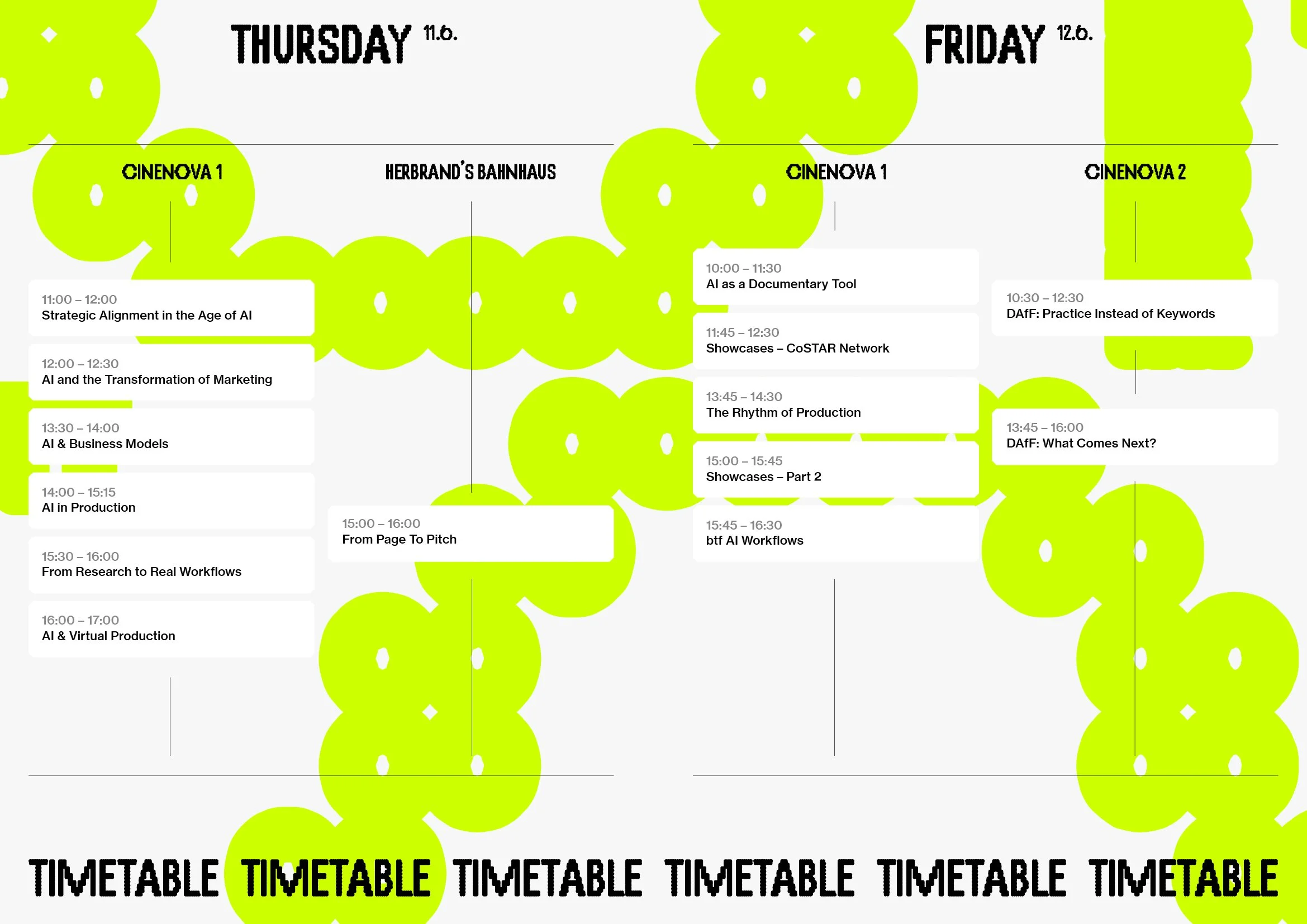
The programme

As budgets in the television industry come under increasing pressure, new technologies are beginning to transform not only the way content is produced, but also how it is financed, distributed, and monetized. In this session, Rémi Tereszkiewicz (BetaSeries) explores how AI-driven processes are shaping emerging business models in the world of television series.
BBC Research & Development offers behind the scenes of how one of Europe’s major public broadcasters is testing, building and applying AI-driven technologies in real production contexts. Graeme Phillipson and Hell Raymond-Hayling present a range of current BBC R&D projects and how they solve concrete production challenges.

As AI-powered tools continue to evolve at a rapid pace, they are not only changing what can be produced, but also fundamentally transforming how projects are developed, planned, and executed. This session brings together two complementary perspectives on how generative AI is reshaping production processes in development, VFX, and post-production.
How can a well-known book series be brought to life visually before a single scene has even been filmed? Using the specific case study of Penny Pepper, this deep dive demonstrates how freely available AI tools can be used to develop a mood trailer and compelling visuals.
With the rapid spread of new technologies in the audiovisual industry, decision-makers are faced with a key question: How is the rise of AI-powered tools changing the strategic landscape of the film and television industry? And what does this mean for broadcasters and production companies?
Few industries have adopted AI as quickly and extensively as marketing. From data-driven targeting to the automated creation and distribution of content, AI-powered tools have fundamentally transformed how campaigns are designed, produced, and delivered.
Virtual production is undergoing a profound transformation, fueled by rapid advances in artificial intelligence. What was once a highly specialized field is quickly becoming a core component of contemporary production workflows. Yet the true catalyst of this shift is not the technology alone but how innovation is developed, tested, and ultimately shared across the industry.
TERRA X HISTORY: ROADTRIP 1945, a ZDF production by Doclights, demonstrates how AI-powered visual effects can unlock new forms of nonfiction storytelling by making the unfilmable visible. Faced with the challenge of reconstructing historical journeys and perspectives for which little to no visual material exists, the team developed a narrative approach that combines documentary rigor with image generation and VFX workflows.
This session brings together a new generation of AI-driven start-ups and companies shaping the future of film. From development and production to post-production, distribution, and audience engagement, each company represents a different point along the cinematic value chain. Together, they offer a glimpse into how artificial intelligence is transforming creative workflows, unlocking new forms of storytelling, and redefining collaboration across the industry.
In this case study, Serienwerft offers an inside look at how AI-supported tools are being integrated into high-volume series production. Using the tool RECAP, developed by Decamerone, the team explores its application within the writer’s room and across production planning for the long-running daily drama ROTE ROSEN.
In this session, btf bildundtonfabrik offers a practical look at how AI-supported tools are beginning to reshape workflows across development, production and post-production. Rather than replacing creative roles, the focus lies on how existing processes can evolve through closer integration between traditionally separated production phases.
Imagine key art production without complex marketing shoots: how generative AI models can be used to create high-quality authentic talent imagery for promotion and advertising. Which prompting strategies, AI model choices and AI workflows will do the job – faster and cheaper?
Stephan Ottenbruch, Board Member of the German Academy of Television, will present the Academy’s AI workshop, which trains creatives in fiction film and television professions in the use of AI tools. The focus is on the fields of cinematography, make up and hair design, set design, directing, editing, and production.
What technological developments will shape the film and television industry in the coming years? The speakers will discuss the future applications of AI, new forms of creative collaboration, and changes to existing production processes.